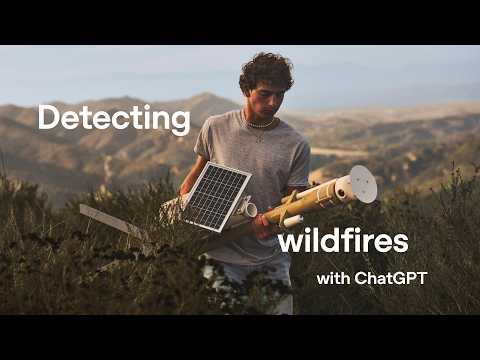
Video by OpenAI via YouTube

More about our next generation voice model here: https://openai.com/index/introducing-gpt-live/
Overview: The Changing Face of Open Source This week’s digest captures a pivotal moment for open source, where AI is both a powerful tool and a source of new challenges. From smarter drone navigation to code upgrades, the community is grappling with how to integrate AI without losing the human-centric values that define open source. … Read more
Video by OpenAI via YouTube

More about our next generation voice model here: https://openai.com/index/introducing-gpt-live/
Video by OpenCV via YouTube

Autonomous drones only fly as well as they can figure out where they are. Drop one into a forest, a dense city, or a disaster zone, and that gets a lot harder — the signals they normally lean on just aren’t there. This week we get into HUNT, a navigation approach built for exactly the places where the usual answers fall apart.
OpenCV is a 501(c)(3) registered non-profit in the United States. See how you can support open source CV & AI: http://opencv.org/support/
Watch along for your chance to win during our live trivia segment, and participate in the live Q&A session with questions from you in the audience.
Become a paid member of the channel to help us make more episodes https://www.youtube.com/channel/UCkrcW82Y2kbgU-U9RaYfgxw/join
Got a cool project of your own? Send it to us and you may be featured https://www.jotform.com/form/233105358823151
Thumbnail by Natalia de la Rosa natdlrs.com
Video by NetApp Instaclustr via YouTube

Learn how OpenSearch’s sparse_vector field type enables neural sparse search — and see it running live on an OpenSearch cluster, all in under 6 minutes.
In this video, Ramya breaks down what sparse_vector is, how it differs from knn_vector, the key parameters you need to know when configuring it, and walks through a complete working example on OpenSearch Dashboards. By the end, you’ll know how to create a sparse vector index, ingest documents with token-weight pairs, run your first neural sparse search query — and how to decide when to use sparse_vector versus knn_vector.
If you haven’t seen the knn_vector video yet, I’d recommend starting there for context — it covers the dense vector side of the same story.
Watch now: https://youtu.be/lzygNYpVT-s
Learn more:
▶️ Full blog article (deep dive): https://www.instaclustr.com/blog/understanding-opensearch-vector-field-type-part-2-sparse_vector/
▶️ Try NetApp Instaclustr free trial: https://console2.instaclustr.com/signup
▶️ How to create an OpenSearch cluster on Instaclustr: https://www.youtube.com/watch?v=2RU-YqW5zsk
Be sure to subscribe for all things OpenSearch!
Video by FOSSASIA via YouTube

Build map-powered mobile apps without vendor lock-in. In this FOSSASIA Summit 2026 session, Masashi Katsumata introduces MapConductor, an open-source middleware SDK that provides a unified API for popular map platforms, including Google Maps, Mapbox, ArcGIS, HERE, and MapLibre.
Discover how MapConductor simplifies cross-platform development by abstracting multiple map SDKs behind a consistent interface, reducing migration costs and allowing developers to focus on application logic instead of provider-specific implementations. The session also covers the project’s architecture, technical challenges, live demos, and roadmap toward a community-driven open-source ecosystem.
FOSSASIA Summit 2026 held in Bangkok, is Asia’s leading Open Source tech conference featuring sessions on #AI, #Cloud, #DevOps, #Open Hardware, #Security, #Web #Mobile Technologies, #Web3, and #Databases. Learn more: http://summit.fossasia.org
Session slides: https://eventyay.com/ev/88882f3e/talk/J7ZLCWT17WR1/
#FOSSASIA #FOSSASIASummit #opensource #FOSS
Video by Sudo Show via YouTube

Open source maintainers keep the world’s infrastructure running—but the “promotion” from contributor to maintainer can feel like a trap. In this clip from SUDO Show 77, Bill, Neal, and Noel talk about maintainer burnout, what we can learn from Linus Torvalds’ approach to leadership in the Linux kernel, and where AI managers might fit into the future of FOSS and DevOps teams.
Video by FINOS via YouTube

Erik Seliger (Lead Product Engineer at Sourcegraph) and Robert Lin (Lead Platform Engineer at Sourcegraph) join FINOS Zenith Project Lead Peter Smulovics to break down the mechanics of Agentic Batch Changes. They reveal how implementing a multi-layered agent architecture solves the high economic cost of pure "vibe coding" by combining deterministic scripting pipelines with localized, token-efficient AI coding models.
🗽 Catch Us in New York! Ready to scale your repository automation while defending corporate token budgets?
Join the enterprise DevOps community at OSFF New York on November 4–5, 2026.
🎟️ Register Now: https://hubs.ly/Q04n_bZL0
🔥 25% OFF DISCOUNT CODE: FINOSREDOSFF25
🕒 Timestamps:
0:00 Reminders: Call for Proposals and Exclusive OSFF New York Perks
1:35 Thank You to Our NY Sponsors: Red Hat, Moderne, and Temporal
1:59 Introducing Sourcegraph: Powering Code Intelligence for Global Banks
3:26 Session Kickoff: The Concept of Multi-Layered Agentic Code Modification
4:03 What is a Batch Change? Overcoming Tedious Multi-Repo Migrations
4:38 The Log4j Reality Check: Scaling Vulnerability Patches Across 25,000 Services
5:15 Why Developers Hate Manual Modernization Campaigns (and Cookie Bribes)
6:11 Scriptable Boundaries: The Limitations of Pre-AI Automation
6:38 Meet the Outer Loop: The Deterministic Project Manager Agent
7:15 Inner Loop Coordination: When to Program vs. When to Burn Tokens
8:48 The Cost Moat: Crafting Markdown Spec Files for Repeatable Scale
10:10 Before vs. After AI: Shifting From Manual Find-and-Replace to Self-Correction
11:09 Staged Validation: Running Contextual Code Search via DeepSearch
11:58 Scripting Efficiencies: Leveraging Automated Ecosystem Tools Natively
12:57 Approachable Migration: Watching Git Patches Evolve in Real-Time
14:09 The Prevention Moat: Stopping the Scope Creep of Automation Platforms
14:48 Bring Your Own Model: Swapping Outer Engines vs. Experience Tuning
16:15 Out-of-the-Box Setup: Integrating Native Sourcegraph MCP Connections
17:37 Deterministic Plus Agent Mix: The Quality Boost of Hybrid Recipes
19:10 Automating the Container Image Base via Outer Loop Orchestrators
19:59 Hook Blocks: Deploying Coding Agents to Automatically Fix Failed CI Pipelines
21:20 Deterministic Log Fetching: Pruning API Trajectories to Eradicate Waste
22:23 The Spectacular Scripting Flaw: How AI Wrote a Humongous Switch Case
23:26 Accessing the Beta: How Existing Enterprises Can Test Agentic Scale
24:32 The Ultimate Inflection Point: Flipping the Machine From a Money Burner to Magic
📊 The Problem: The Economic Nightmare of Unbounded "Vibe Coding" When global financial institutions attempt large-scale codebase modifications—such as upgrading framework dependencies across 25,000 active code services—relying on a single coding model introduces severe fragmentation. Traditional coding assistants immediately blow through millions of context-window tokens trying to execute code changes repo-by-repo. Furthermore, when these blind refactoring attempts trigger continuous integration (CI) failures, the model encounters a non-deterministic loop, spinning out out-of-bounds calculations, custom exceptions, and configuration drift that burns cash without hitting production.
🏗️ The Solution: The Multi-Layered Agentic Batch Architecture Sourcegraph delivers a structural framework that decouples project coordination from individual script executions:
The Outer Loop Project Manager: Running an orchestration agent governed by immutable system prompts to research, manage repository staging, and continuously audit diff outputs.
Deterministic Baseline Integration: Using the planning agent to write efficient, low-cost scripts for programmatic tasks (like straightforward find-and-replace or package manager updates) instead of burning tokens on every file.
Inner Loop Containment: Deploying localized coding engines (such as Cody or Cloud Code) strictly inside isolated base Docker images to handle ambiguous, complex code edge cases on demand.
⚙️ Why This Matters for Financial Engineering
Automated CI Hook Blocks: Injecting localized AI hooks directly into failing build logs, empowering inner loop agents to dynamically correct pipeline issues in real time based on compilation feedback.
Deep MCP Integration: Setting up customized Model Context Protocol (MCP) layers to bridge context lines, letting inner agents instantly ask the master outer orchestrator for repository-scale search data when hitting technical roadblocks.
🌐 More about FINOS: https://www.finos.org/
📧 Join our newsletter: https://www.finos.org/sign-up
🎙️ Listen to our Open Source in Finance Podcast: https://www.youtube.com/@FINOS/podcasts
LinkedIn: https://www.linkedin.com/company/finosfoundation
#FINOS #OSFFNewYork #Sourcegraph #BatchChanges #ZenithProject #DevOps #MultiAgent #TokenEfficiency #CIFixing #MCP
Video by The Late Night Linux Family via YouTube

Support us on Patreon and get an ad-free RSS feed with some early episodes. https://www.patreon.com/LateNightLinux
Mozilla is paying for Firefox to be on the front of Wrexham football shirts, SCO vs IBM might not be dead after all, Red Hat will support RHEL forever if you are willing to pay, OpenMandriva discovers why distros need good governance, Félim awaits his statue, and a quick Kagi update.
https://latenightlinux.com/late-night-linux-episode-394/
Video by TWiT Tech Podcast Network via YouTube

MacBreak Weekly covers all things Apple: Leo, Andy Ihnatko, Jason Snell, and Christina Warren analyze every bit of news from the most interesting company in tech. From AI to Vision Pro, iPad to iPhone, these Apple experts know-all and tell-all.
You can find more about TWiT.tv and subscribe to our full shows at https://podcasts.twit.tv
Join our community at Club TWiT: https://twit.tv/clubtwit
About us:
TWiT.tv is a technology podcasting network located in the San Francisco Bay Area with the #1 ranked technology podcast This Week in Tech hosted by Leo Laporte. Every week we produce over 30 hours of content on a variety of programs including Tech News Weekly, MacBreak Weekly, Windows Weekly, Security Now, Intelligent Machines, and more.
Community Events and Collaborations Social Coworking Sessions: The SORTEE community continues its social coworking and office hours, fostering collaboration among open scientists. Additionally, a session focusing on Vale and text linting tools helps improve documentation quality. World Music Day Edit-a-thon 2026: A global event to create and improve Wikipedia articles about music, culture, and history, … Read more