Video by PyTorch via YouTube
PyTorch 2.15 makes the rewritten NCCL backend the default, tunes NVGEMM for low-precision decode, adds FP8 and decode-specific kernels on Apple Silicon, and expands accelerator platform support. The release is composed of 3,117 commits from 583 contributors since PyTorch 2.14.
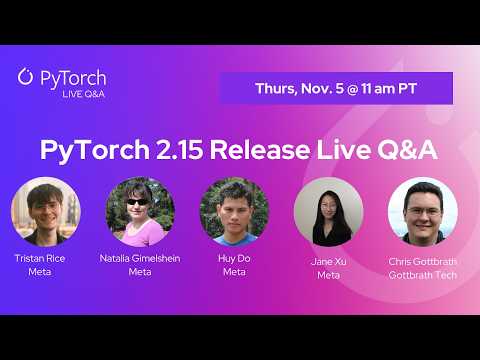
Bring any questions you may have about PyTorch 2.15 to our Q&A webinar on Thursday, November 5, 2026, at 11 AM PT. Tristan Rice, Natalia Gimelshein, Huy Do, and Jane Xu (all Meta) will share an overview of the 2.15 release and answer community questions about PyTorch and the new capabilities in this release, moderated by Chris Gottbrath (Gottbrath Tech).
PyTorch 2.15 covers:
– The rewritten NCCL backend becoming the default, with a flight recorder that dumps on hangs and TORCH_DIST_USE_NCCL2=0 or nccl-legacy as rollback paths
– One-sided transports for torch.distributed, with a NIXL backend and CUDA-graph-capturable transfers
– Finer memory and communication control in FSDP2 and pipelining, with fp32 for precision-sensitive parameters, CUDA-graph-captured gradient accumulation, and gradient reduction overlapped with compute
– Faster 4-bit (NVFP4) LLM decoding on NVIDIA Blackwell GPUs through fewer, better-overlapped kernel launches in NVGEMM
– FP8 support and faster decode on Apple Silicon, with float8_e4m3fn and _scaled_mm, a new grouped_mm with a decode fast path, and public torch.mps.Stream APIs
– Broader platform support with FlyDSL kernels on AMD gfx950, preview Tensor Data Mover support for gfx1250 (MI450), ROCm 10.0 wheels, simpler SYCL kernel authoring and multi-GPU profiling on Intel GPUs, CUDA 13.2 as the default wheel with CUDA 13.4 alongside it, and torch.compile on Python 3.15