
Video by OpenSourceLowTech via YouTube

A quick and dirty description of how the device basically functions.
Video by OpenSourceLowTech via YouTube
A quick and dirty description of how the device basically functions.

Video by OpenAI via YouTube
GPT-6 Astra achieves state-of-the-art results on benchmarks for long-running computer-use tasks across professions and desktop apps, which means anything you can do on a computer, Astra can do for you, fast.
It’s also the best model for software engineering to date and our most aligned model yet, with improvements in honesty and reductions in deceptive behavior.
GPT-6 Astra is rolling out today for enterprises and customers in our Trusted Access Program, with broad availability in ChatGPT Work and Codex coming to Plus, Pro, Business and Enterprise plans, and API and AWS customers in the next few days.
To experience Astra at its best, use the ChatGPT desktop app.
“Put That There" clip courtesy of MIT Media Laboratory, Chris Schmandt, and Eric Hulteen.

Video by OpenCV via YouTube
The goal behind this session is to explain to developers how Visual SLAM maps differ from VPS maps, and how to approach challenges such as short-term and long-term relocalization. We will also explore the differences between machine-readable and human-readable maps, and why both need to coexist to support orchestration and coordination tasks occurring within the same physical space.
OpenCV is a 501(c)(3) registered non-profit in the United States. See how you can support open source CV & AI: http://opencv.org/support/
Watch along for your chance to win during our live trivia segment, and participate in the live Q&A session with questions from you in the audience.
Become a paid member of the channel to help us make more episodes https://www.youtube.com/channel/UCkrcW82Y2kbgU-U9RaYfgxw/join
Got a cool project of your own? Send it to us and you may be featured https://www.jotform.com/form/233105358823151
Thumbnail by Natalia de la Rosa natdlrs.com

Video by PyTorch via YouTube
Richard Liaw of Ray discusses the project’s focus on building useful, critical AI infrastructure and the importance of Ray within the broader AI stack. He also speaks about maintaining Ray as an open, well-governed project that continues to evolve with its community.
PyTorch Conference North America returns October 20–21, 2026, in San Jose.
Register: https://hubs.la/Q04w5M9L0

Video by NetApp Instaclustr via YouTube
With Instaclustr you can put Iceberg tables on FSxN and querying it with ClickHouse.
Try it for yourself with a free 30 day trial: https://console2.instaclustr.com/signup
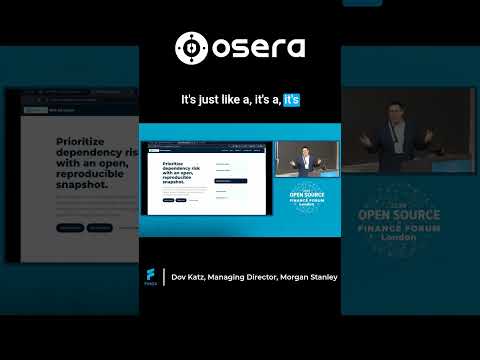
Video by FINOS via YouTube
Measuring AI developer productivity is harder than just counting merged PRs. The real test? Using AI to drastically reduce your organization’s vulnerability backlog from 500,000 to 100,000. See how quantifying CWE and CVE reduction proves actual security ROI. Discover how collaborative initiatives like FINOS OSERA help developers securely manage dependencies at scale. #DevSecOps #AI #OSERA

Video by Sudo Show via YouTube
Linux does not need to imitate Windows to be useful. Michael Tunnell, Bill, Neal, and Noel explain why switching with an open mind matters, why Windows is not inherently “easy,” and how Linux offers its own workflows, tools, and freedoms worth learning.

Video by Awesome Open Source via YouTube
=== Links ===
Show Notes:
https://wiki.opensourceisawesome.com/books/open-source-gaming/page/install-get-puzzles
Forgejo Repo
https://forge.routemehome.org/brian/get_puzzles
Get the AwesomeOpenSource Merchandise
https://osia.printify.me
Support my Channel and ongoing efforts through Patreon:
https://patreon.com/awesomeopensource
Buy Me a Coffee or Beer
https://paypal.me/BrianMcGonagill?country.x=US&locale.x=en_US
=== Get My Novel ===
Entanglement – by Brian McGonagill
Dave is just a normal guy with a normal job that he doesn’t like that much. That is, until he meets Leo, and gets the job he never imagined. Action, adventure, betrayal, love, loss, and some serious weirdness happen throughout this science fiction thrill-ride.
— eBook on Amazon by Country —
US – United States – https://www.amazon.com/dp/B0DZJ5PMHG
UK – United Kingdom – https://www.amazon.co.uk/dp/B0DZJ5PMHG
DE – Germany – https://www.amazon.de/dp/B0DZJ5PMHG
FR – France – https://www.amazon.fr/dp/B0DZJ5PMHG
ES – Spain – https://www.amazon.es/dp/B0DZJ5PMHG
IT – Italy – https://www.amazon.it/dp/B0DZJ5PMHG
NL – Netherlands – https://www.amazon.nl/dp/B0DZJ5PMHG
JP – Japan – https://www.amazon.co.jp/dp/B0DZJ5PMHG
BR – Brazil – https://www.amazon.com.br/dp/B0DZJ5PMHG
CA – Canada – https://www.amazon.ca/dp/B0DZJ5PMHG
MX – Mexico – https://www.amazon.com.mx/dp/B0DZJ5PMHG
AU – Australia – https://www.amazon.com.au/dp/B0DZJ5PMHG
IN – India – https://www.amazon.in/dp/B0DZJ5PMHG
— Paperback by Country —
US – United States – https://www.amazon.com/dp/B0DZPM682N
UK – United Kingdom – https://www.amazon.co.uk/dp/B0DZPM682N
DE – Germany – https://www.amazon.de/dp/B0DZPM682N
FR – France – https://www.amazon.fr/dp/B0DZPM682N
ES – Spain – https://www.amazon.es/dp/B0DZPM682N
IT – Italy – https://www.amazon.it/dp/B0DZPM682N
NL – Netherlands – https://www.amazon.nl/dp/B0DZPM682N
PL – Poland – https://www.amazon.pl/dp/B0DZPM682N
SE – Sweden – https://www.amazon.se/dp/B0DZPM682N
JP – Japan – https://www.amazon.co.jp/dp/B0DZPM682N
CA – Canada – https://www.amazon.ca/dp/B0DZPM682N
AU – Australia – https://www.amazon.com.au/dp/B0DZPM682N
— Hard cover by Country —
US – United States – https://www.amazon.com/dp/B0DZPVSRNZ
UK – United Kingdom – https://www.amazon.co.uk/dp/B0DZPVSRNZ
DE – Germany – https://www.amazon.de/dp/B0DZPVSRNZ
FR – France – https://www.amazon.fr/dp/B0DZPVSRNZ
ES – Spain – https://www.amazon.es/dp/B0DZPVSRNZ
IT – Italy – https://www.amazon.it/dp/B0DZPVSRNZ
NL – Netherlands – https://www.amazon.nl/dp/B0DZPVSRNZ
PL – Poland – https://www.amazon.pl/dp/B0DZPVSRNZ
SE – Sweden – https://www.amazon.se/dp/B0DZPVSRNZ
=== Timestamps ===
00:00 Beginning
00:01 Introduction
00:44 Get Puzzles Overview
09:23 Install and Setup Get Puzzles
10:50 Setting up a basic Server
12:40 Setting up the Docker Configuration
15:00 Setting up the .env file
16:50 Install Docker
17:15 Add user to Docker Group
17:40 Pull the Get Puzzle images
18:40 Setup the init.sql script file
19:20 Bring up our Game
=== Contact ===
Matrix: @mickintx:discuss.opensourceisawesome.com
Mastodon: @MickInTx@fosstodon.org
=== Special Thanks ===
Gabriela Lopez – Video Editor
=== Affiliates ===
Get a super cheap, yet pwerful VPS at Racknerd
https://my.racknerd.com/aff.php?aff=14764
Get a $50.00 credit for Digital Ocean by signing up with this link:
https://m.do.co/c/a6a61ae55242
Use Hover as your Domain Name Registrar to get some great control over you domains / sub-domains:
https://hover.com/SHPaiirr
Support my Channel and ongoing efforts through Patreon:
https://patreon.com/awesomeopensource

Video by Open Data Science and AI Conference via YouTube
Robot Psychologists
Want to learn more about AI in person? Check out ODSC AI West 2026, coming to SF this October 27th-29th: https://odsc.ai/west
#DataScience #AI #ArtificialIntelligence #ODSCAI
————————————————————————————————————-
Visit our website and choose the nearest ODSC event to attend and experience all our training and workshops: https://odsc.ai
To watch more videos like this, visit https://aiplus.training
Sign up for the newsletter to stay up to date with the latest trends in data science: https://opendatascience.com/newsletter/
Follow us online!
• Facebook: https://www.facebook.com/OPENDATASCI
• Instagram: https://www.instagram.com/odsc/
• Blog: https://opendatascience.com/
• LinkedIn: https://www.linkedin.com/company/open-data-science/
• X (twitter): https://x.com/_odsc

Video by The Late Night Linux Family via YouTube
Support us on Patreon and get an ad-free RSS feed with some early episodes. https://www.patreon.com/LateNightLinux
What to read into a study of long-term Backblaze hard drive failure data, why the difference between TB and TiB matters, and what to do about an overheating host bus adapter.
https://2.5admins.com/2-5-admins-315/