
Video by OpenAI via YouTube

ChatGPT Work keeps projects moving. Monitoring what matters, surfacing what needs attention, and picking up where your team leaves off.
Video by OpenAI via YouTube
ChatGPT Work keeps projects moving. Monitoring what matters, surfacing what needs attention, and picking up where your team leaves off.

Video by Hugging Face via YouTube
Quick case study persistent memory for AI agents featuring Mem0. The architecture of long form memory for agents goes far beyond a vector search. This deep dive explains Mem0’s memory stores, ingestion pipeline, hybrid retrieval with semantic search, BM25 and entity boosting, plus practical open models for running the system locally.
—
🔗 *Links*
– Mem0 documentation: https://docs.mem0.ai/
– Mem0 source code: https://github.com/mem0ai/mem0
– Hugging Face models: https://huggingface.co/models
– Hugging Face embedding models: https://huggingface.co/models?pipeline_tag=feature-extraction
– MTEB leaderboard: https://huggingface.co/spaces/mteb/leaderboard
—
👋 *Connect with me*
– My website: https://alejandro-ao.com/
– X (Twitter): https://x.com/_alejandroao
– LinkedIn: https://www.linkedin.com/in/alejandro-ao/
—
🤓 *Topics Covered*
– Long-term memory architecture for AI agents
– Mem0 ingestion, storage and hybrid retrieval
– Local LLM and embedding model choices
—
⏱️ *Timestamps*
0:00 Introduction
0:55 What agent memory is
3:28 Persistent memory across agents
4:26 Databases used by Mem0
8:06 Memory ingestion
15:30 Retrieval: queries and semantic search
19:19 Retrieval: BM25 and entity boosting
25:38 Open models and conclusion
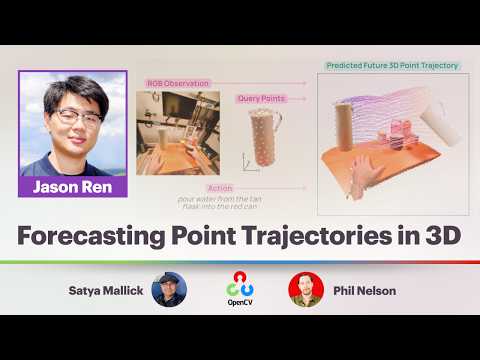
Video by OpenCV via YouTube
Join Jason Ren of Ai2 (Allen Institute for AI) for MolmoMotion: Forecasting Point Trajectories in 3D with Language Instruction, a live look at how open multimodal models move past describing a scene to predicting where things go next. Building on the Molmo family’s pointing and tracking capabilities, MolmoMotion takes a plain-language instruction and forecasts point trajectories through 3D space, so the model answers by showing exactly where and when motion will happen. Expect live demos, a walk through the training data and recipe, and a discussion of what this opens up for robotics, video understanding, and embodied agents.
OpenCV is a 501(c)(3) registered non-profit in the United States. See how you can support open source CV & AI: http://opencv.org/support/
Watch along for your chance to win during our live trivia segment, and participate in the live Q&A session with questions from you in the audience.
Become a paid member of the channel to help us make more episodes https://www.youtube.com/channel/UCkrcW82Y2kbgU-U9RaYfgxw/join
Got a cool project of your own? Send it to us and you may be featured https://www.jotform.com/form/233105358823151
Thumbnail by Natalia de la Rosa natdlrs.com

Video by CNCF [Cloud Native Computing Foundation] via YouTube
Don’t miss out! Join us at our next KubeCon + CloudNativeCon events in Shanghai, China (8-9 September, 2026) and Salt Lake City, United States (Nov 9–12, 2026). Connect with our current graduated, incubating, and sandbox projects as the community gathers to further the education and advancement of cloud native computing. Learn more at https://kubecon.io
Lightning Talk: Using Keycloak Authorization Service for Kubernetes Service-to-Service Authorization – Halil Özkan, Keymate
Modern Kubernetes environments often centralize identity but still leave service-to-service authorization spread across
application code, gateway rules, and proxy-specific configuration. This session presents a practical pattern for using
Keycloak Authorization Services as a centralized authorization control plane while enforcing decisions at the platform
layer instead of inside each application.
The talk shows how Kubernetes workloads can remain unchanged while a mesh-level Policy Enforcement Point evaluates HTTP
requests using workload identity, request metadata, and centrally managed policy. The architecture uses Istio Ambient
mode, waypoint proxies, a WebAssembly-based enforcement extension, and a Keycloak-backed decision flow.
The session also covers allow and deny behavior, fail-closed handling, bypass-prevention requirements, observability
with OpenTelemetry, and the latency and reliability trade-offs that appear when Keycloak participates in the live
authorization path. A live demo shows both the enforcement path and the operational signals it produces.

Video by FINOS via YouTube
David Shone (Senior Director, Data & Digital Solutions at ISDA) highlights why celebrating community achievements, milestone contributions, and open-source champions with tangible recognition drives real momentum across financial tech standards.
🗽 Catch Us at OSFF New York! Meet global open-source leaders and industry champions at OSFF New York on November 4–5, 2026.
🎟️ Register Now: https://hubs.ly/Q04n_bZL0
🔥 20% OFF DISCOUNT CODE: 26YTOSFFNY20C
#Shorts #FINOS #ISDA #OpenSource #FinTech #DeveloperRecognition #CommunityGrowth

Video by Open Data Science and AI Conference via YouTube
Most professionals are now using AI tools, but the next step is learning how AI systems, agents, and automated workflows are actually built. In this session, we’ll break down the core skills behind modern AI builders – from LLMs, prompting, context, memory, tools, retrieval, and evaluation to coding assistants, workflow automation, and agentic systems.
This session is designed for both technical and non-technical professionals. We’ll cover how developers are using tools like Codex, Claude Code, Cursor, and GitHub Copilot to build faster, while also looking at how managers, analysts, marketers, sales teams, product leaders, and operations teams can use AI agents and workflow tools to automate real work.
You’ll leave with a practical roadmap for moving from AI user to AI builder, including what to learn first, which concepts matter most, and how the ODSC AI Accelerator provides a structured hands-on path for going deeper.
Who should attend:
AI practitioners, data scientists, analysts, software developers, ML engineers, data engineers, product managers, business leaders, operations teams, sales and marketing professionals, and anyone looking to build practical skills with AI agents and workflows.

Video by TWiT Tech Podcast Network via YouTube
A DEF CON attendee’s attempt to hack airplane Wi-Fi caused issues. They jammed the onboard signal and broadcasted a fake ‘Delta Wi-Fi Fast’ network, causing a pilot alert. Don’t do this! #DEFCON #CyberSecurity #Hacking #AirplaneSafety #ACARS

Introduction The open-source landscape is buzzing with activity, especially in the AI sector. From new developer tools like DeepSeek’s agent harness to Alibaba’s staggering download numbers, the ecosystem is evolving rapidly. This digest highlights the most impactful stories, offering insights into trends, security concerns, and the growing influence of Chinese tech giants. For developers and … Read more

Introduction This week’s open source news is a whirlwind of activity, from AI’s massive impact on cloud native tech to exciting developments in Linux desktop and gaming. A common thread emerges: the push for openness and community-driven innovation, even as big players like NVIDIA and OpenAI make moves. For those invested in open source, these … Read more

Video by CNCF [Cloud Native Computing Foundation] via YouTube
Submitting talks, reviewing them as a program committee member, running sponsor booths: Prithvi Raj has done it all across 14 KubeCon + CloudNativeCon events. He shared why it’s become a core part of his life at KubeCon + CloudNativeCon Japan.
#KubeCon #CloudNative