LF Live Webinar: The Cap(AI)bility Edge

LF Live Webinar: The Cap(AI)bility Edge

Video by The Linux Foundation via YouTube
LF Live Webinar: The Cap(AI)bility Edge

The Cap(AI)bility Edge: Why Workforce Upskilling Is Becoming the Defining Competitive Advantage of the AI Era

Sponsored by LF Education, LF Research, & KodeKloud

AI is reshaping the technical workforce faster than most organizations can respond. But the story playing out in the headlines about AI eliminating jobs, shrinking teams, and displacing developers, is not the story the data tells.

The 2026 State of Tech Talent Report reveals a different reality: AI is a net driver of job creation in IT (+31% net hiring effect in 2026), and the organizations struggling most are not struggling because they can’t find people. They’re struggling because they lack the capAIbility to deploy AI safely, securely, and at scale.

Security concerns have jumped from the last-place barrier to technology adoption in 2024 to the number-one barrier in 2026. Most organizations haven’t deployed the foundational infrastructure AI requires. And the talent gap is not just in AI, it runs across the full stack: platform engineering, DevOps, cloud native, and cybersecurity.

The organizations pulling ahead aren’t the ones buying more AI tools. They’re the ones investing in workforce capability, developing their existing people, preserving institutional knowledge, and building the validated, job-ready skills that production AI actually demands.

Source

Open Source Digest: SORTEE, UNESCO, Flood Tools & More

Open Source Digest: SORTEE, UNESCO, Flood Tools & More

Community & Collaboration The open source community is buzzing with activities that bridge disciplines and organizations. The Society for Open, Reliable, and Transparent Ecology and Evolution (SORTEE) invites members and newcomers to their social coworking and office hours, providing a space for collaborative work and networking. This initiative fosters a supportive environment for researchers passionate … Read more

Set Up Your Account in 5 Steps | H2O.ai Managed Cloud

Set Up Your Account in 5 Steps | H2O.ai Managed Cloud

Video by H2O.ai via YouTube
Set Up Your Account in 5 Steps | H2O.ai Managed Cloud

Follow the full activation path for H2O.ai Managed Cloud, from the invitation email through multi-factor authentication to your first login.

Access to H2O.ai Managed Cloud runs through an External Okta account. This is the identity platform customers and partners use to reach H2O.ai environments and the support portal.

Before you start, your H2O.ai contact is the entry point. If you are evaluating the platform, request access at h2o.ai/demo or through a sales representative, and qualified opportunities may receive a time-bound sandbox. If you are already a customer, your account representative or customer success manager provides access.

Covered in this video:
Step 1: receive your invitation email and find the secure activation link
Step 2: activate your account
Step 3: set a password that meets the criteria
Step 4: configure multi-factor authentication with a security question and an authenticator app
Step 5: reach your environment from the access portal or a custom link

Activation links expire after a limited time. If yours has lapsed, contact your administrator or support@h2o.ai for a new one.

LINKS
H2O.ai University: https://h2o.ai/university
Documentation: https://docs.h2o.ai
Request access or a demo: https://h2o.ai/demo
Support: support@h2o.ai

ABOUT H2O.ai
H2O.ai builds the platform enterprises use to develop, deploy, and operate AI on their own private data, across predictive machine learning and generative AI.

#Okta #EnterpriseAI #H2Oai

Source

Agent Memory EXPLAINED – Complete Architecture

Agent Memory EXPLAINED - Complete Architecture

Video by Hugging Face via YouTube
Agent Memory EXPLAINED - Complete Architecture

Quick case study persistent memory for AI agents featuring Mem0. The architecture of long form memory for agents goes far beyond a vector search. This deep dive explains Mem0’s memory stores, ingestion pipeline, hybrid retrieval with semantic search, BM25 and entity boosting, plus practical open models for running the system locally.

—
đź”— *Links*
– Mem0 documentation: https://docs.mem0.ai/
– Mem0 source code: https://github.com/mem0ai/mem0
– Hugging Face models: https://huggingface.co/models
– Hugging Face embedding models: https://huggingface.co/models?pipeline_tag=feature-extraction
– MTEB leaderboard: https://huggingface.co/spaces/mteb/leaderboard

—
đź‘‹ *Connect with me*
– My website: https://alejandro-ao.com/
– X (Twitter): https://x.com/_alejandroao
– LinkedIn: https://www.linkedin.com/in/alejandro-ao/

—
🤓 *Topics Covered*
– Long-term memory architecture for AI agents
– Mem0 ingestion, storage and hybrid retrieval
– Local LLM and embedding model choices

—
⏱️ *Timestamps*
0:00 Introduction
0:55 What agent memory is
3:28 Persistent memory across agents
4:26 Databases used by Mem0
8:06 Memory ingestion
15:30 Retrieval: queries and semantic search
19:19 Retrieval: BM25 and entity boosting
25:38 Open models and conclusion

Source

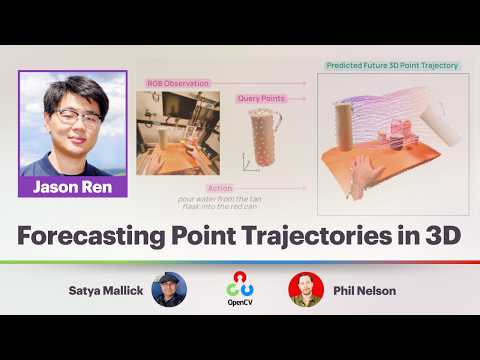
MolmoMotion: Forecasting Point Trajectories in 3D with Language Instruction – OpenCV Live! 221

MolmoMotion: Forecasting Point Trajectories in 3D with Language Instruction - OpenCV Live! 221

Video by OpenCV via YouTube
MolmoMotion: Forecasting Point Trajectories in 3D with Language Instruction - OpenCV Live! 221

Join Jason Ren of Ai2 (Allen Institute for AI) for MolmoMotion: Forecasting Point Trajectories in 3D with Language Instruction, a live look at how open multimodal models move past describing a scene to predicting where things go next. Building on the Molmo family’s pointing and tracking capabilities, MolmoMotion takes a plain-language instruction and forecasts point trajectories through 3D space, so the model answers by showing exactly where and when motion will happen. Expect live demos, a walk through the training data and recipe, and a discussion of what this opens up for robotics, video understanding, and embodied agents.

OpenCV is a 501(c)(3) registered non-profit in the United States. See how you can support open source CV & AI: http://opencv.org/support/

Watch along for your chance to win during our live trivia segment, and participate in the live Q&A session with questions from you in the audience.

Become a paid member of the channel to help us make more episodes https://www.youtube.com/channel/UCkrcW82Y2kbgU-U9RaYfgxw/join

Got a cool project of your own? Send it to us and you may be featured https://www.jotform.com/form/233105358823151

Thumbnail by Natalia de la Rosa natdlrs.com

Source

Lightning Talk: Using Keycloak Authorization Service for Kubernetes Service-to-Service… H. Özkan

Lightning Talk: Using Keycloak Authorization Service for Kubernetes Service-to-Service… H. Özkan

Video by CNCF [Cloud Native Computing Foundation] via YouTube
Lightning Talk: Using Keycloak Authorization Service for Kubernetes Service-to-Service… H. Özkan

Don’t miss out! Join us at our next KubeCon + CloudNativeCon events in Shanghai, China (8-9 September, 2026) and Salt Lake City, United States (Nov 9–12, 2026). Connect with our current graduated, incubating, and sandbox projects as the community gathers to further the education and advancement of cloud native computing. Learn more at https://kubecon.io

Lightning Talk: Using Keycloak Authorization Service for Kubernetes Service-to-Service Authorization – Halil Ă–zkan, Keymate

Modern Kubernetes environments often centralize identity but still leave service-to-service authorization spread across
application code, gateway rules, and proxy-specific configuration. This session presents a practical pattern for using
Keycloak Authorization Services as a centralized authorization control plane while enforcing decisions at the platform
layer instead of inside each application.

The talk shows how Kubernetes workloads can remain unchanged while a mesh-level Policy Enforcement Point evaluates HTTP
requests using workload identity, request metadata, and centrally managed policy. The architecture uses Istio Ambient
mode, waypoint proxies, a WebAssembly-based enforcement extension, and a Keycloak-backed decision flow.

The session also covers allow and deny behavior, fail-closed handling, bypass-prevention requirements, observability
with OpenTelemetry, and the latency and reliability trade-offs that appear when Keycloak participates in the live
authorization path. A live demo shows both the enforcement path and the operational signals it produces.

Source

Celebrating Open Source Wins: Why Recognition Matters | David Shone

Celebrating Open Source Wins: Why Recognition Matters | David Shone

Video by FINOS via YouTube
Celebrating Open Source Wins: Why Recognition Matters | David Shone

David Shone (Senior Director, Data & Digital Solutions at ISDA) highlights why celebrating community achievements, milestone contributions, and open-source champions with tangible recognition drives real momentum across financial tech standards.

🗽 Catch Us at OSFF New York! Meet global open-source leaders and industry champions at OSFF New York on November 4–5, 2026.
🎟️ Register Now: https://hubs.ly/Q04n_bZL0
🔥 20% OFF DISCOUNT CODE: 26YTOSFFNY20C

#Shorts #FINOS #ISDA #OpenSource #FinTech #DeveloperRecognition #CommunityGrowth

Source

From AI User to AI Builder: The Skills You Need to Build AI Agents and Workflows

From AI User to AI Builder: The Skills You Need to Build AI Agents and Workflows

Video by Open Data Science and AI Conference via YouTube
From AI User to AI Builder: The Skills You Need to Build AI Agents and Workflows

Most professionals are now using AI tools, but the next step is learning how AI systems, agents, and automated workflows are actually built. In this session, we’ll break down the core skills behind modern AI builders – from LLMs, prompting, context, memory, tools, retrieval, and evaluation to coding assistants, workflow automation, and agentic systems.

This session is designed for both technical and non-technical professionals. We’ll cover how developers are using tools like Codex, Claude Code, Cursor, and GitHub Copilot to build faster, while also looking at how managers, analysts, marketers, sales teams, product leaders, and operations teams can use AI agents and workflow tools to automate real work.

You’ll leave with a practical roadmap for moving from AI user to AI builder, including what to learn first, which concepts matter most, and how the ODSC AI Accelerator provides a structured hands-on path for going deeper.

Who should attend:
 AI practitioners, data scientists, analysts, software developers, ML engineers, data engineers, product managers, business leaders, operations teams, sales and marketing professionals, and anyone looking to build practical skills with AI agents and workflows.

Source