I was stunned! NVIDIA’s new Nemotron Lightning model, running on a single Spark, outperformed competitors like Flash and Qwen by over 2x, making zero mistakes. An open-weight marvel. #NemotronLightning #NVIDIA #AIModels #TechInnovation
You can find more about TWiT and subscribe to our full shows at https://podcasts.twit.tv/
Subscribe: https://twit.tv/subscribe
Products we recommend: https://www.amazon.com/shop/twitnetcastnetwork
TWiT may earn commissions on certain products.
Join our TWiT Community on Discourse: https://www.twit.community/
Get Theme Studio – Massive Introductory Discount
https://payhip.com/LinuxTex
On April 15th, the European Commission declared its new age verification app "technically ready." By the very next day, a security researcher had hacked it — in under two minutes. But the hack isn’t the real story. Buried in the technical specification is a single sentence about hardware attestation that could quietly lock Linux users, custom Android ROMs, and de-Googled phones out of Europe’s digital identity future.
In this deep dive, we break down the EU age verification app and the European Digital Identity (EUDI) Wallet it’s built on: zero-knowledge proofs that reveal nothing but your age, the Secure Enclave / StrongBox secure-hardware mandate, Google Play Integrity and why GrapheneOS fails the "strong" level despite being more secure, the Remote WSCD option that could fix desktop Linux but was never implemented, and Switzerland’s vendor-neutral Hardware Attestation API that proves a better path exists. We also look at the global picture — the UK’s VPN surge, Australia’s under-16 social media ban, and the California and Colorado open-source carve-outs that prove community pushback actually works.
To be precise: the EU is NOT banning Linux. But its trust architecture defaults to hardware and app stores run by two companies — and the disadvantage that creates for desktop Linux, Linux phones, and custom ROMs is structural, not stated. Here’s what that means for you, and the three things to watch as this gets decided.
🎨 Check out Theme Studio — the most powerful, most complete GNOME theming app. GTK theme, Shell, icons, accent color, and a matching 4K wallpaper — all in one click:
https://payhip.com/LinuxTex
Timestamps:
0:00 Intro
0:59 What the EU Actually Built
3:11 Theme Studio
4:25 The Fine Print
6:59 Who Gets Left Out
8:55 The Bigger Picture
9:52 My Thoughts
👍 If you found this video useful, subscribe for more Linux deep dives and open-source news.
💬 Question of the day: If your country rolled this out tomorrow, would you verify through your phone, or would you want a desktop path? Let me know in the comments.
Video by OpenProject | Open Source Project Management via YouTube
Make project reporting faster with saved project list views.
In this quick guide, see how Daphne configures a project list view, saves it to favorites, and exports project data as a PDF to make monthly reporting faster and easier.
“There’s an old adage that performance can be a feature because when something becomes fast enough, it changes behavior.”
Today we’re previewing Ultrafast mode, a new service tier in the OpenAI API for GPT‑5.6 Sol. Powered by Cerebras, Ultrafast runs up to 14x faster than Standard processing and generates up to 750 output tokens per second.
OpenAI technical staff are already seeing what that speed changes. One security investigation workflow that once took one to two hours now takes 10–15 minutes, sometimes approaching real time. In other workflows, staff use Ultrafast to investigate root causes, search systems in parallel, and stay in flow while coding.
Ultrafast is available to a select group of API customers, with access expanding as capacity grows.
Fraud detection, demand forecasting, document intelligence, and retrieval-augmented generation all run on the same platform, under the same governance model.
This lesson maps what you can actually build on H2O.ai Managed Cloud. The platform is structured around three pillars: modelling and automation, where models get built and refined; AI applications and data engineering, where models become systems people can use; and deployment, monitoring, and governance, where AI runs reliably in production.
Within that structure, predictive AI answers what is likely to happen, and generative AI answers how you can generate, reason, and automate knowledge. Both work across structured data like transactions and time series, and unstructured data like text, images, and audio.
Covered in this video:
The three platform pillars and what each one is responsible for
Predictive AI use cases: fraud detection, demand forecasting, credit risk, churn prediction, anomaly detection
Generative AI use cases: enterprise assistants, document intelligence, summarization, RAG, agentic workflows
How operationalization is built in, covering secure deployment, scalable infrastructure, monitoring, and governance
LINKS
H2O.ai University: https://h2o.ai/university
Documentation: https://docs.h2o.ai
Request access or a demo: https://h2o.ai/demo
Support: support@h2o.ai
ABOUT H2O.ai
H2O.ai builds the platform enterprises use to develop, deploy, and operate AI on their own private data, across predictive machine learning and generative AI.
Video by CNCF [Cloud Native Computing Foundation] via YouTube
In this episode, CNCF Ambassador Vyom Yadav explores Inspektor Gadget for the first time, with CNCF Maintainer Qasim Sarfraz live on stream to navigate obstacles and elaborate on features encountered during the demo.
Inspektor Gadget is a CNCF Sandbox project designed to inspect and debug Kubernetes applications and infrastructure.
Core Capabilities
* Resource Inspection: Monitors and inspects running
* Kubernetes resources directly within the cluster environment.
* Application Debugging: Helps identify and troubleshoot application and system behaviors in real time.
* Live Event Tracing: Captures system events to support operational observation and troubleshooting.
* Kubernetes Context Mapping: Links system-level insights directly to Kubernetes pods, nodes, and namespaces.
Join us for this practical, live dive into Inspektor Gadget!
Former acting U.S. Comptroller of the Currency Michael Hsu joins FINOS Chief Data Officer Jane Gavronsky to announce the official relaunch of the Open RegTech initiative. Michael breaks down the systemic friction of analog banking compliance, demonstrating how regulators and global institutions can eliminate duplicate legal interpretations by issuing machine-readable regulations backed by open standards.
🗽 Catch Us in New York! Ready to explore the future of executable regulation, open standards, and RegTech innovation? Join us at OSFF New York on November 4–5, 2026.
🎟️ Register Now: https://hubs.ly/Q04n_bZL0
🔥 20% OFF DISCOUNT CODE: 26YTOSFFNY20C
🕒 Timestamps:
0:00 Introduction: Relaunching Open RegTech at FINOS
0:58 Mutualizing Non-Competitive Regulatory Workflows
1:50 Michael Hsu Keynote: The Analog Regulation Problem
2:58 Deconstructing the Regulatory Stack: Intent, Spec, and Duplication
4:40 Proving the Concept: How CDM and DRR Transformed Derivatives Reporting
5:50 The Paradigm Shift: Regulators Issuing Regulation as Code
6:20 Three Tailwinds Accelerating Regulation as Code: Streamlining, Proven CDM, and AI
7:28 From Prose to Code: Completing the Machine-Readable Stack
8:35 Vibe Coding Rules: Using AI to Accelerate Regulatory Prototyping
9:46 Widening the Scope: Expanding Past Derivatives to Liquidity, BSA, and AML
10:50 Pilot Priorities: Riding the Streamlining Wave and Targeting 2052-A Reports
11:59 Default to Machine Readable: Replacing "Cassette Tape" PDF Regulations
12:70 Call to Action: Pick a Spot, Build on CDM, and Join the Open RegTech SIG
📊 The Problem: The High Economic Cost of Analog PDF Regulation
For decades, financial regulation has operated as a slow, analog assembly line: regulatory agencies draft rules in text documents, publish them as static PDFs, and hand them off to banks. At individual institutions, armies of lawyers, risk officers, and consultants manually read, interpret, and convert those PDFs into custom data schemas, rule logic, and reporting scripts. This constant duplication across thousands of firms burns immense capital, slows innovation, and creates massive operational risk due to inconsistent legal interpretations.
🏗️ The Solution: The Open RegTech Shared Regulatory Stack
Michael Hsu lays out a roadmap to modernize regulatory compliance using open source and AI:
Common Domain Model (CDM) Foundation: Utilizing an open-source, industry-standard data schema so financial trades, transactions, and reporting fields share a single digital definition across firms.
Digital Regulatory Reporting (DRR) Logic: Standardizing rule execution logic (via projects like ISDA’s DRR) to eliminate duplicate firm-by-firm interpretation layers.
Regulation as Code: Encouraging regulators to issue new rules natively as machine-readable code alongside prose text, enabling financial institutions to plug regulatory logic straight into compliance engines.
⚙️ Why This Matters for Financial Engineering
AI-Accelerated Modernization: Leveraging generative AI to rapidly translate legacy regulatory text into structured, machine-readable specifications and rule logic.
Targeting High-Friction Reports: Expanding machine-readable frameworks past derivatives reporting into massive, daily regulatory filings like U.S. 2052a liquidity reports, U.K. PRA 110 reports, and BSA/AML compliance.
🌐 More about FINOS: https://www.finos.org/
📧 Join our newsletter: https://www.finos.org/sign-up
🎙️ Listen to our Open Source in Finance Podcast: https://www.youtube.com/@FINOS/podcasts
LinkedIn: https://www.linkedin.com/company/finosfoundation
Video by Open Data Science and AI Conference via YouTube
In this episode, Sheamus McGovern sits down with Michael Schrage, Research Fellow at the MIT Sloan School of Management’s Initiative on the Digital Economy, to explore Vibe Analytics—a new approach to using generative AI to uncover insights, challenge assumptions, generate hypotheses, and ask better questions.
The conversation covers promptathons, actionable insights, intelligent KPAIs, and why the future of analytics is less about getting answers and more about improving how we think with AI.
00:00 Why insights matter more than answers
01:05 Introducing Michael Schrage & Vibe Analytics
02:08 AI, human capital, and becoming better thinkers
04:00 From Vibe Coding to Vibe Analytics
07:12 Is Vibe Analytics changing how we reason with data?
10:00 Why answers aren’t enough
12:00 AI, critical thinking, and cognitive offloading
20:20 Insights vs. actionable insights
23:04 What is a Promptathon?
26:10 From dashboards to AI-powered decision making
28:20 How Promptathons work
33:00 Why disagreement with AI creates better insights
36:00 The new skill: asking better questions
37:00 Why philosophy matters in the age of AI
40:15 Making your data "talk back"
43:30 Contradictions, hypotheses, and experimentation
45:20 From KPIs to intelligent KPAIs
47:20 The future role of data analysts
49:00 How to introduce Vibe Analytics in your organization
50:00 Where to learn more & closing remarks
Visit our website and choose the nearest ODSC event to attend and experience all our training and workshops: https://odsc.ai
To watch more videos like this, visit https://aiplus.training
Sign up for the newsletter to stay up to date with the latest trends in data science: https://opendatascience.com/newsletter/
Follow us online!
• Facebook: https://www.facebook.com/OPENDATASCI
• Instagram: https://www.instagram.com/odsc/
• Blog: https://opendatascience.com/
• LinkedIn: https://www.linkedin.com/company/open-data-science/
• X (twitter): https://x.com/_odsc
AI adoption is moving from experimentation to enterprise impact. But what does it take to scale AI responsibly?
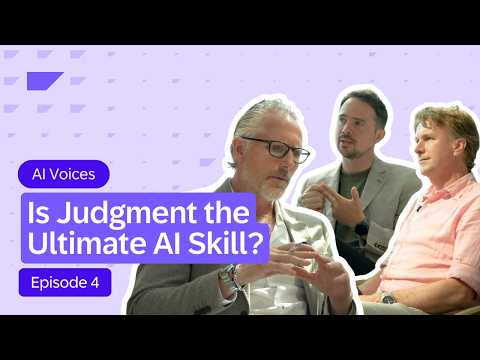
In this episode of AI Voices, host Jesper Schleimann, SAP’s Head of Business AI for EMEA, speaks with Ignacio Bonetto, Manager of Emerging Technologies at @DamenShipyardsYT, and Ronald Schippers, Managing Director of VNSG, the Dutch SAP User Group.
Together, they explore how organizations are moving beyond AI buzzwords and pilots toward real business value. The conversation looks at the shift from bottom-up experimentation to top-down strategic intent, the importance of change management, and why leaders must help teams build the confidence, literacy, and judgment needed to work effectively with AI.
You’ll hear first-hand perspectives on how AI is changing knowledge work in industries like shipbuilding, why access to information is no longer the main challenge, and how “decision compression” can help organizations accelerate processes and rethink business models. The discussion also explores the human side of AI: accountability, leadership, workforce readiness, and the growing need for professionals who can evaluate what is valuable, right, and wrong.
For business and technology leaders, this episode offers a grounded look at what it means to scale AI with purpose, governance, and human judgment at the center.
Explore SAP Business AI:
https://sap.to/6052B1P4EA
Chapters
00:00 – Decision compression and human accountability
00:23 – Welcome to AI Voices
00:53 – How AI adoption has changed
03:14 – AI across the Dutch SAP user community
05:04 – From shipbuilder to maritime solution provider
07:12 – Decision compression and business model change
09:37 – Preparing for the future of AI
10:51 – Cautious optimism around autonomous enterprise
13:17 – AI, context, and complex knowledge work
15:17 – Experts on demand and intent-driven work
16:42 – Leadership, intent, and accountability
19:12 – Moving from experimentation to strategic value
20:08 – Final advice: start now
21:09 – Closing thoughts
Follow us on social:
LinkedIn: https://sap.to/6053B1P4E7
Instagram: https://sap.to/6054B1P4EC
Facebook: https://sap.to/6057B1P41B
Threads: https://sap.to/6058B1P418
About SAP:
As a global leader in enterprise applications and business AI, SAP stands at the nexus of business and technology. For over 50 years, organizations have trusted SAP to bring out their best by uniting business-critical operations spanning finance, procurement, HR, supply chain, and customer experience. For more information, visit: https://sap.to/6050B1P41E
We use cookies on our website to give you the most relevant experience by remembering your preferences and repeat visits. By clicking “Accept All”, you consent to the use of ALL the cookies. However, you may visit "Cookie Settings" to provide a controlled consent.
This website uses cookies to improve your experience while you navigate through the website. Out of these, the cookies that are categorized as necessary are stored on your browser as they are essential for the working of basic functionalities of the website. We also use third-party cookies that help us analyze and understand how you use this website. These cookies will be stored in your browser only with your consent. You also have the option to opt-out of these cookies. But opting out of some of these cookies may affect your browsing experience.
Necessary cookies are absolutely essential for the website to function properly. These cookies ensure basic functionalities and security features of the website, anonymously.
Cookie
Duration
Description
cookielawinfo-checkbox-analytics
11 months
This cookie is set by GDPR Cookie Consent plugin. The cookie is used to store the user consent for the cookies in the category "Analytics".
cookielawinfo-checkbox-functional
11 months
The cookie is set by GDPR cookie consent to record the user consent for the cookies in the category "Functional".
cookielawinfo-checkbox-necessary
11 months
This cookie is set by GDPR Cookie Consent plugin. The cookies is used to store the user consent for the cookies in the category "Necessary".
cookielawinfo-checkbox-others
11 months
This cookie is set by GDPR Cookie Consent plugin. The cookie is used to store the user consent for the cookies in the category "Other.
cookielawinfo-checkbox-performance
11 months
This cookie is set by GDPR Cookie Consent plugin. The cookie is used to store the user consent for the cookies in the category "Performance".
viewed_cookie_policy
11 months
The cookie is set by the GDPR Cookie Consent plugin and is used to store whether or not user has consented to the use of cookies. It does not store any personal data.
Functional cookies help to perform certain functionalities like sharing the content of the website on social media platforms, collect feedbacks, and other third-party features.
Performance cookies are used to understand and analyze the key performance indexes of the website which helps in delivering a better user experience for the visitors.
Analytical cookies are used to understand how visitors interact with the website. These cookies help provide information on metrics the number of visitors, bounce rate, traffic source, etc.
Advertisement cookies are used to provide visitors with relevant ads and marketing campaigns. These cookies track visitors across websites and collect information to provide customized ads.